
Smyth Realiser A8, un casque multicanal avec sensation d’espace
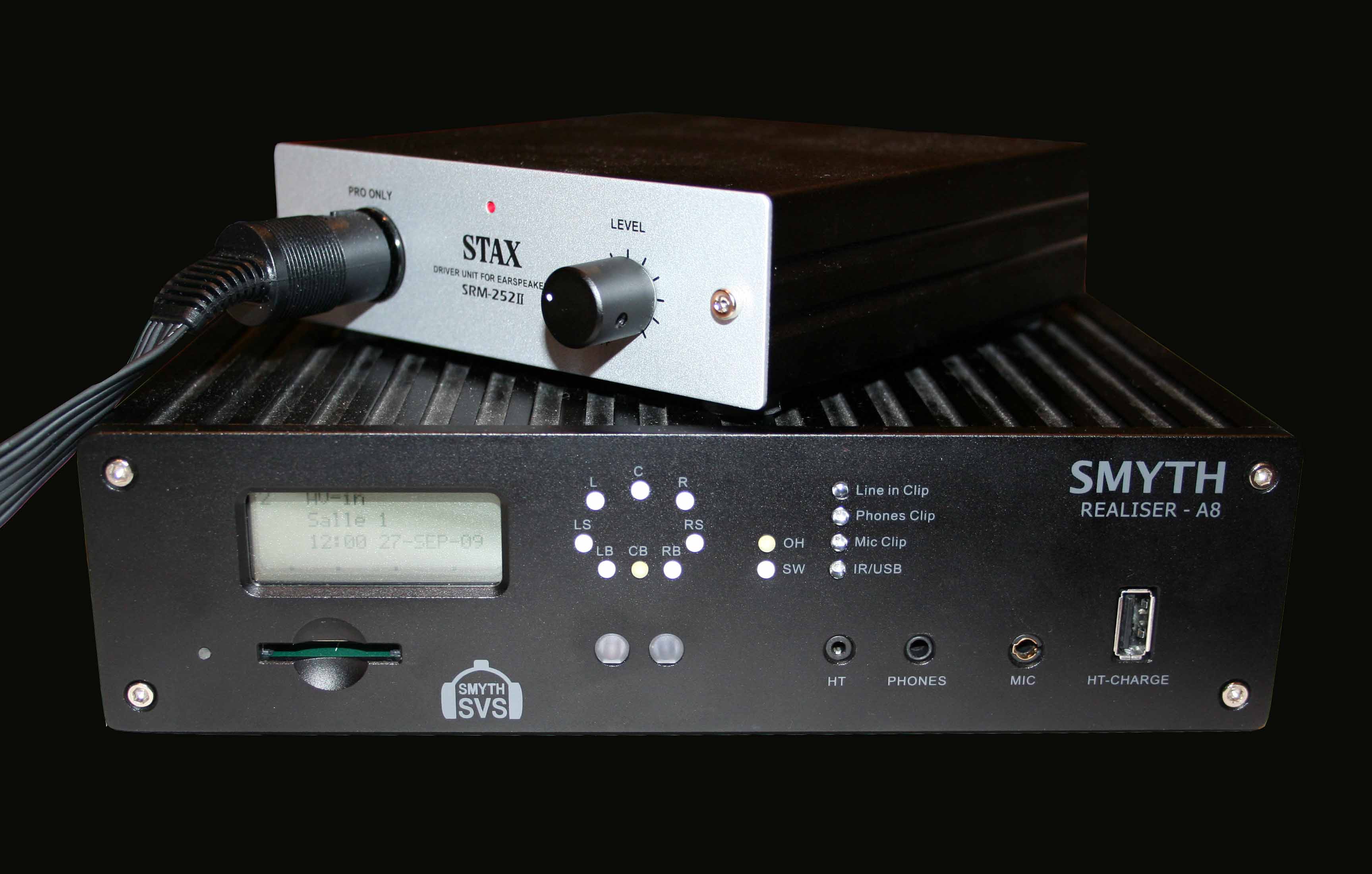
Le Realiser A8 Smyth est un processeur d’écoute multicanal pour le casque, compatible 5.1 jusqu’à 8 canaux (8.0 ou 7.1). Il permet d’extérioriser l’écoute à travers n’importe quel casque stéréo grâce à la simulation de nos fonctions de transfert HRTF (head related transfer function). Les fonctions de transfert HRTF sont les courbes de réponse en fréquence de notre tête incluant nos épaules et les lobes de nos oreilles, elles diffèrent pour chaque angle de localisation d’une source. Nous avons par exemple, pour une source donnée à 120° par rapport à l’axe 0° de l’enceinte centrale (ce qui correspond à l’enceinte arrière gauche ou arrière droite) une perte d’environ 10 dB entre 1,5 kHz et 7 kHz par effet de masque de notre tête.
Il existe aujourd’hui diverses solutions de reproduction de l’espace pour le casque. Toutes appliquent le principe de correction HRTF aux canaux entrant, à partir d’informations générales ou moyennées de formes et de dimensions de pavillons de l’oreille, de têtes et de torses.
Sans procédé de virtualisation, un son monophonique écouté au casque positionne la source au centre de la tête, tandis qu’un signal stéréo positionne les sons sur une ligne de gauche à droite en passant par le centre de la tête, mais jamais en dehors comme dans la vraie vie. Avec une source multicanale, les procédés de son surround virtuel ouvrent effectivement la perception et l’élargissent même quelquefois au-delà du casque. La localisation arrière des canaux surround fonctionne bien souvent. En revanche, la localisation frontale est plus limitée, avec notamment un canal central difficile à « visualiser » devant soi. Dans tous les cas, aucun de ces procédés ne peut prétendre reproduire parfaitement la localisation obtenue à partir de cinq ou davantage enceintes réparties autour de l’auditeur.
Pourtant, dans ses principes de base, le Realiser est similaire aux autres systèmes : il applique une altération HRTF aux différentes voies du multicanal. Néanmoins, le Realiser fait en plus appel à trois composants critiques absents des autres procédés : la personnalisation, le suivi des mouvements de tête et la capture des propriétés de n’importe quel système sonore dans son environnement d’origine. La personnalisation est réalisée par la mesure de nos propres fonctions HRTF et le suivi des mouvements de tête se fait par recalcul des paramètres de ces fonctions toutes les 5 ms. Ce procédé vise aussi à simuler une écoute multicanal en reproduisant son identité et l’acoustique du local dans lequel on fait la mesure. On peut donc imaginer transporter dans le processeur notre écoute multicanal favorite, bien optimisée, n’importe où.
La calibration du preset se fait en deux temps, nous calibrons dans un premier temps le système pour mesurer nos propres fonctions HRTF, la réponse en fréquence des enceintes et la mesure acoustique du local, ces mesures s’appellent les PRIR (personnal room impulse response). Dans un second temps nous calibrons le système pour l’adapter au casque utilisé, la mesure HPEQ, afin de linéariser en fréquence la restitution. Nous avons donc au final deux mesures regroupées en un preset. Nous pouvons ensuite garder les mesures PRIR faites et changer de casque ou bien garder le même casque et charger une autre écoute multicanal mesurée auparavant, stockée dans la mémoire. L’unité comporte 64 mémoires PRIR et 64 mémoires HPEQ chargées dans 4 presets utilisateurs. Le Realiser est vendu avec un casque Stax SR-202 en option mais peut fonctionner avec tout autre casque stéréo.
Suite aux tests d’écoute réalisés, la réaction de la plupart des gens est de demander de couper l’écoute multicanal pour démarrer les tests…alors que les tests ont déjà commencé ! Les tests ont été faits sur une écoute AIR 6 dynaudio acoustics. Parmi les différents procédés d’écoute multicanal pour casque déjà testés (Arkamys, Fraunhofer, Dolby headphones, Headzone Beyer), le Realiser offre de grandes possibilités en terme de sensation d’espace. Après comparaison, les localisations des différents canaux du casque correspondent précisément aux localisations des enceintes de l’écoute multicanal. Les canaux arrières restent toujours très impressionnants car ils portent des directions de provenance nouvelles dont on n’a vraiment pas l’habitude de percevoir au casque. On retrouve aussi l’identité des enceintes et du local (réverbération). La calibration haute résolution (sweep de durée 12 s contre 3 s en basse résolution) améliore sensiblement la perception externe en frontal ainsi que le rendu acoustique avec une meilleure perception de profondeur.
Nous retrouvons dans le Realiser 8 la plupart des réglages de gestion du son multicanal, le choix des angles des enceintes, le réglage du niveau de référence (85 dB C SPL cinéma ou 79 dB C SPL TVHD), le réglage de la configuration Lfe à + 10 dB ou 0 dB, le bass management avec la fréquence de coupure à 80 Hz, le downmix stéréo avec la possibilité de renseigner les coefficients associés au centre et aux arrières, cette réduction étant diffusée sans spatialisation, de façon traditionnelle. Les entrées et sorties sont analogiques en RCA, on trouve aussi une sortie casque numérique SPDIF, des sorties audio auxiliaires pour raccorder des transducteurs tactiles (body shakers) afin de renforcer la sensation de vibration avec le corps et une version professionnelle est prévue d’ici le deuxième trimestre 2010 (E/S sur Sub25 analogique et AES). On peut synchroniser deux Realiser si l’on souhaite restitituer des formats multicanal jusqu’à 16 canaux audio permettant ainsi d’explorer la restitution verticale (10.2, aurophonic system 10…).
Les applications sont nombreuses autant dans le milieu professionnel (cars HD, prise de son…) que pour le grand public (jeux vidéo, films, musique…), mais c’est surtout globalement une nouvelle façon d’écouter au casque très séduisante et plus naturelle, comparable au passage de l’écoute stéréo vers l’écoute 5.1. Le Realiser peut servir de référence en rappelant notre écoute 5.1 optimisée et tester la compatibilité de notre mixage. Il est possible d’enregistrer la sortie du Realiser et de transporter le format vers un lecteur mobile afin de profiter de l’écoute spatiale. On peut aussi imaginer un boitier optimisé pour la prise de son reportage/documentaire qui permettrait enfin au preneur de son d’avoir un rendu spatial de sa prise de son multicanal autrement que par l’écoute frontale ou arrière ou du downmix restant très limitée ! A tester impérativement !
En savoir plus :